Showing posts with label Archaeology Month. Show all posts

Thursday, October 28, 2021

Cemeteries - Stories of the Past

When was the last time you were at a cemetery? For many it was likely to bury a loved one- a family member or a dear friend. It’s likely that you didn’t look around at the other cemetery markers, unless they were family members, and think about the individuals who are represented by the marker.  Most of us wouldn’t consider a cemetery to be a garden or park, or that it may have been arranged based on political or social status. We tend to think of cemeteries as a final resting place for the dead, a place we might visit to pay respect and reflect upon a memory.

Preservation movements across the United States have begun to recognize the significant resources preserved in cemeteries; these are not simply the source of genealogical records, but they also represent important cultural sites on the regional landscape and their significance varies for different ethnic groups.  Unfortunately, they are threatened by development and neglect that is eradicating them from the landscape.  In rural areas family cemeteries were frequently located near a few trees or some other marker on the landscape that may no longer exist.  Recording the locations and data associated with cemeteries has become a preservation initiative for many groups at the local, state, and national level.

Figure 1- Rural cemetery marked by a black walnut tree and iron fence, Tioga County

In Pennsylvania, the State Historic Preservation Office (SHPO) has created a process in PA-SHARE for recording cemeteries in a Cultural Resources Geographic Information System (CRGIS).  The help page for this site will guide you in completing the required information. This office has also been involved in efforts to improve guidance for state agencies surrounding the treatment of cemeteries. This work was initially inspired by the discovery in 2016 of a cemetery on Arch Street in Philadelphia during a construction project.  The site was the location of burial grounds for the First Baptist Church of Philadelphia. The remains of more than 400 individuals dating to between 1700 and 1860 were recovered during an emergency salvage archaeology project conducted by volunteer archaeologists in the area. Unfortunately, this is just one example of cemeteries being lost in the historic record, only to be discovered “at the last minute” during a construction project.  

Protection of Native American cemeteries gained momentum in 1990 with the passage of the Native American Graves Protection and Repatriation Act (NAGPRA). Unfortunately, many grave sites were looted and destroyed before this Act went into effect, and some are still threatened by this criminal activity

Attention has grown within the African American community for finding, recording, and preserving their ancestral cemeteries. The Pennsylvania Hallowed Grounds project is drawing attention to preservation of cemeteries and is specifically focused on honoring Pennsylvania’s United States Colored Troops (USCT), veterans of the American Civil War who fought in African American regiments. The Lincoln Cemetery in Cumberland County was recently placed on the county register of Historic Places. Twelve African American veterans of the U.S. Civil War, members of the U.S. Colored Troops, are interred here along with the remains of other members of the African American community dating back as early as 1862.  This cemetery was recognized as important to the community by members of the Vietnam Veterans of Mechanicsburg who took on the task of cleaning and restoring the overgrown cemetery. This is an excellent example of the local community recognizing the contributions and sacrifices of these soldiers and honoring their final resting place. 

The difficulty in tracing these individuals and African American cemeteries in general can be attributed to several factors.  Enslaved peoples were often buried in unmarked graves in remote areas, family members may have been sold, or for some, escaped via the underground railroad. Graves were sometimes marked with wooden staffs or in coastal areas, piles of shells delineated the burial. Often these types of markers were lost or decayed, leaving no trace of the grave itself and no record of the individual buried there.  After the Civil War, families often moved out of the area and future generations never returned. Cemeteries in more urban settings were equally as threatened by development and racist treatment of African American burial grounds. Segregated cemeteries didn’t receive the same treatment and respect as the more affluent cemeteries and were often the first sold by local governments. Historic records often indicate that graves were moved but have proven to be inaccurate at best. Oral histories preserved in the local communities have often been the best resource for preserving these burial grounds.


Figure 2- Henry S. Ward, Colored Troops Veteran, Mount Tabor Cemetery, Mount Holly Springs, Cumberland County


Archaeologists from the Pennsylvania Historical and Museum Commission recently met with the Friends of the Lebanon Cemetery in York, York County to discuss efforts for preserving this African American cemetery.  The cemetery was begun in 1872 but contains remains of individuals originally buried in other locations and moved to this site. Some graves were marked, but many were not. Community members have researched the family members who are buried here and have worked diligently at cleaning up the cemetery and recording data on head stones. Soil erosion on a steep hillside has led to damaged headstones and misplaced or buried markers.  The group was seeking assistance in locating unmarked graves and guidance for best practices in sharing their information. Staff from the SHPO’s office, The State Museum of Pennsylvania, and West Chester University toured the area and considered options for this group. West Chester University archaeologist Dr. Heather Wholey, and students suggested creating a detailed map of the graves along with the gravestone information as an initial step in this project.  Newer technology for identifying graves including the use of drones and remote sensing surveys were also discussed as possible options.  GroundPenetrating Radar (GPR) is a method employed by archaeologists to identify disturbances and anomalies in the soil.  It is a non-destructive method for mapping data into a GIS system which enables the identification of potential burials and provides a plan or map of the cemetery. 

Figure 3 Lebanon Cemetery, York


Recognizing cemeteries as cultural landscapes and the data that can be gleaned from them is an important effort in understanding our past.  Identifying the individuals, the communities and ultimately the cultures represented in each of these cemeteries is gaining recognition as a resource for archaeologists, historians, genealogists, and preservationists.  Cemeteries associated with communities that sprang up along the Underground Railroad show patterns of movement and cultural adaptation. Understanding the past of the underrepresented allows us to evaluate deeper social issues of injustice and racism. 

African American cemeteries have always represented significant places in African American society, but conditions did not allow these cemeteries to achieve the same prominent monuments as white cemeteries. They are now being recognized as significant monuments that serve to memorialize African American individuals and their contributions that are not recognized elsewhere in white history books.

Preserving cemetery records is vital for groups researching their community and individuals searching for their ancestors. Awareness of the significance of these documents is fundamental to this preservation effort. Archival institutions such as the Pennsylvania State Archives have the tools and technology necessary to preserve records for future generations.  Recent federal legislation was created to record and preserve African American cemeteries; this initiative will also help to unite resources for local community-led programs.

On October 30th, 2021, The State Museum of Pennsylvania will host the annual Workshops in Archaeology program as a virtual program. This year’s focus on African American stories revealed through archaeology and cemetery projects across the Commonwealth and mid-Atlantic will expand on this topic. Presentations by archaeologists and historians promise to raise awareness of the contributions made to Pennsylvania and the nation. Please join us for this informative event by registering at http://statemuseumpa.org/event/2021-annual-workshops-archaeology/


For more information, visit PAarchaeology.state.pa.us or the Hall of Anthropology and Archaeology at The State Museum of Pennsylvania .

Friday, October 15, 2021

The Most Common Artifact Recovered from Precontact Archaeological Sites - Let’s Get Flakey

October is Archaeology Month and to celebrate, The State Museum of Pennsylvania announces its annual ‘Workshops in Archaeology’ conference to be held on Oct. 30, 2021. Due to concerns with COVID-19, this will be a virtual only event, registration is required. The topic of the Workshops this year is Hidden Stories: Uncovering African American History through Archaeology and Community Engagement. To learn more please review our previous blog post and register for this event on our web page http://statemuseumpa.org/WorkshopsinArchaeology

For additional programming please visit the Society for Pennsylvania Archaeology, the Pennsylvania Archaeological Council and the Philadelphia Archaeological Forum  . 


The Most Common Artifact Recovered from Precontact Archaeological Sites - Let’s Get Flakey


A basic guide to stone or lithic flake terminology.


        What is the most common artifact recovered from Precontact archaeological sites? Not arrowheads or spear points or pottery sherds that get all of the attention, but flakes – the  unmodified and unused by-product of chipped stone tool production. Also known as chips, detritus, spawls, shatter or over the past twenty years, most commonly labeled as debitage, these artifacts are ubiquitous at Precontact sites. They outnumber the tools by at least 100 to 1. Flakes are usually the first artifacts that are found during site surveys, and sometimes the only evidence of a Precontact occupation but they are frequently overlooked during analysis and usually lumped together as a single artifact type. Flakes are not pretty; they usually appear as relatively small slivers of rock and even the larger pieces are not readily recognizable as artifacts to the untrained eye. For a long period in archaeological research, flakes were not thought to be very useful in interpretating past cultural behavior. For example, the early collections in The State Museum of Pennsylvania from the 1920s and 1930s contain more projectile points, pottery and bone objects than flakes. Up until the 1970s, some professional archaeologists did not bother to curate flakes during otherwise systematically excavated site investigations but tossed them in the trash at the end of the day. “Flakes tell us Native Americans made stone tools – so what!”

       Based on flint knapping experiments beginning in the 1960s, (Crabtree 1972) and becoming common in the 1980s (Callahan 1979), the interest in debitage and the potential contributions to the interpretation of past cultural behavior became more common. Now, the analysis of debitage is usually a regular part of archaeological survey and site reports. These artifacts tell a great deal about the activities at sites and the tools that were being made and as John Whittaker (1994:21) observes, the occupants of a site were “so inconsiderate as to take the useful tools away” so in many cases the flakes are the only evidence to interpret the past.  


Typical core and flake (image from Whittaker 1994)

The literature is now voluminous, and the following will serve as an introductory or basic guide to the terminology used in describing flakes and the analysis of debitage. All flakes are not the same, but they share certain characteristics. Let’s begin with some terminology. The block of stone to be hit is called the core (to the left in the above illustration) and the pieces that fly off are the flakes (to right). Basically, when a hammerstone hits the edge of a core, the force of the hammer is transmitted into the core; energy is most pronounced at the point of impact and gradually dissipates outwardly to the distal end of the flake. The interior surface of the flake, facing the core is the ventral surface. The exterior side of the flake facing out is called the dorsal surface. At or just below the point of percussion, also known as the striking platform, there is a swelling on the ventral surface known as the bulb of percussion. Further down the ventral surface of the flake are ripple marks. On the dorsal surface there are flake scars where previous flakes were removed from the core. These are characteristics found on stone that was broken for stone tool production; they are not commonly found on stone that broke through natural processes.  

A microcore for the production of razor-like blades  (Photo from the Section of Archaeology, The State Museum of Pennsylvania)


Image of a flake illustrating the point of percussion or striking platform, the bulb of percussion, ripples and exterior flake scars. (Image from Whittaker 1994) 


In a sense, making stone tools is comparable to a wood carver whittling wood. It is a subtractive process, beginning with an amorphous shaped natural block of stone and ending with a finished tool. The process of making stone tools is called knapping or more commonly, flint knapping. Knappers use a stone where it is possible to predict the manner in which it breaks. Just as important, knappers must be able to control the break so that tools can be shaped. The characteristics of the lithic material typically used to make chipped stone tools, also known as “toolstone”, is that they are relatively hard, brittle, plastic and homogeneous, containing few impurities. This type of stone breaks with a conchoidal fracture (cone shaped) similar to a bee bee shot through a windowpane. Flakes usually exhibit a subtle curve in one or more directions. In Pennsylvania the most common lithic materials used in the production of chipped stone tools are chert, jasper, quartz, quartzite, argillite and metarhyolite.


         Knapping usually requires three different types of tools to break the stone - two types of hammers and a pointed piece of antler. An
abrading stone is used to prepare and shape the striking platform so that flakes can be more easily and precisely removed. The hard hammer is for breaking up the blocks of stone from the quarry into manageable blanks. These may range in size from a baseball to a bowling ball weighing ten pounds or more. A soft hammer or baton is usually made from antler (moose or elk) or hard wood (ash or hickory) measuring less than a foot in length. These are for thinning the blanks into nearly finished pieces. The final sharpening and shaping is usually performed with a pressure flaker, commonly made from antler. The point of the antler is placed on the edge of the tool and small flakes are pressed off rather than struck. This is the most precise technique of flake removal.

Flint knapping tools (Photo from the Section of Archaeology, The State Museum of Pennsylvania)


Using a hammerstone on a large flake with other knapping tools in foreground (Photo from the Section of Archaeology, The State Museum of Pennsylvania)


Pressure flaking using a pointed antler. (Image from Whittaker 1994)


Pressure flaking the base of a spear point (Photo from the Section of Archaeology, The State Museum of Pennsylvania)

The key to the analysis of debitage is that the hammerstone, the baton and the pressure flaker all produce different shapes of flakes and therefore the different technological activities can generally be identified. Hammerstone flakes are relatively thick and especially the bulb of percussion is pronounced. Hammerstone flakes are generally produced during the initial stages of tool production, so they have fewer flake scars on their dorsal surface and even less evidence of previous flaking and grinding on the striking platform. Baton flakes are relatively thin, and the bulb of percussion is diffused as the percussion blow spreads out evenly below the striking platform. There are usually many flake scars on the dorsal surface coming from multiple  directions and the striking platform shows evidence of grinding and pressure flaking so the flake can be removed more precisely. In addition, when working a biface (a biface is worked on both flat surfaces of the stone), such as a knife or spear points, baton flakes frequently exhibit a distinctive lip on the striking platform. This is a remanent product of the tool edge that offers evidence of the thickness and size of the tool. Pressure flakes are smaller, usually less than ¾ of an inch in length and thin, often with parallel sides and the striking platform is usually more heavily ground for better attachment.


A baton flake illustrating the lip on the platform, the diffuse bulb and numerous flake scars. (Image from Whittaker 1994)


Complicating the analysis of debitage is that less than half of the flakes are normally complete; most are broken in some fashion and therefore the striking platform or bulb of percussion is missing, something not very useful in the analysis of debitage. In addition, these characteristics or attributes are somewhat subjective, and identifying these traits is very time consuming. However, when applied to large collections, the attribute analysis of debitage can be useful in distinguishing different kinds of knapping activities at a site. Identifying the location of early stone tool production, the location of actual tool production areas, the final sharpening and shaping of tools, and the resharpening of tools can be valuable information in the interpretation of activities at a site.

There are other types of flakes that define more specific technological activities such as blade flakes, biface thinning flakes, overshot flakes, bipolar flakes, and platform rejuvenation flakes and these can be the topic of future blogs.  

The foregoing methodology is based on the identification of specific attributes on flakes. Especially, as large state and federal projects in compliance with the National Historic Preservation Act became more common, archaeologists became more concerned with the accuracy of the attribute analysis but also the time involved in flake analysis. In response, a variety of alternative methods have been developed. Generally, these fall under the term aggregate analysis and involve sorting flakes by size using a series of graduated sieves (screens). Needless to say, these other methods are complicated and there is not sufficient space to describe them all here. Spoiler alert, it is generally agreed that the best results are achieved using a combination of attribute analysis and aggregate analysis (Hall and Larson 2004).  

As noted by Jeffery Rasic, considering the high frequency of flakes at sites, they are “one of the primary sources of information about human behavior … being able to reconstruction technological behaviors related to production, use, transport, and maintenance of stone tools … these data and interpretations, in turn can shed light on questions of broader anthropological concern such as the ways people organize their work, subsistence activities, travels, and social and political behavior” (Rasic 2004:114). Many studies have demonstrated that debitage at sites changes during different time periods suggesting that debitage reflects the basic characteristics of the cultural adaptation (Parry 1994).

 We hope you have enjoyed this brief overview of debitage terminology and more carefully examine the next flake you find realizing that it has an interesting story to tell. Please visit our gallery at The State Museum of Pennsylvania to see examples of stone tool production by the Indigenous peoples who developed and perfected this technology.  We also invite you to visit our on-line collections.


References

Callahan, Errett

1979    The Basics of Biface Knapping in the Eastern Fluted Point Tradition: A Manual for Flintknappers and Lithic Analysts. Archaeology of Eastern North America 7:1-180.


Crabtree, Don E.

1972    An Introduction to Flintworking. Occasional Papers no. 28. Pocatello: Idaho State University Museum.


Hall, Christopher T. and Mary Lou Larson

2004    Aggregate Analysis in Chipped Stone. The University of Utah Press, Salt Lake City.


Parry, William

1994    Prismatic Blade Technologies in North America. In The Organization of North American Prehistoric Chipped Stone Tool Technologies, edited by P. J. Carr, pp. 87-98. Archaeological Series No. 7, International Monographs in Prehistory, Ann Arbor.


Rasic, Jeffrey T.

2004    Debitage Taphonomy. In Aggregate Analysis in Chipped Stone, edited by Christopher T. Hall and Mary Lou Larson, pp. 112-135. The University of Utah Press, Salt Lake City.


Whittaker, John C.

1994    Flintknapping: Making and Understanding Stone Tools. University of Texas Press, Austin.


For more information, visit PAarchaeology.state.pa.us or the Hall of Anthropology and Archaeology at The State Museum of Pennsylvania .

Friday, October 12, 2018

Fort Hunter Wrap-up and Archaeology Month Events

3rd in the 'berg at Fort Hunter 2018

The State Museum of Pennsylvania’s Section of Archaeology wrapped up its annual public archaeology excavation this past Friday, October the 5th. Despite this year’s overall soggy season, the program continues to be successful in providing an opportunity for the public to observe an archaeological dig up close, and to learn more about the historic and prehistoric inhabitants that called what is now Fort Hunter Mansion and Park home.

These students are shovel-ready!

Middle school and High school students, college undergraduates as well as home-schooled individuals were introduced to modern survey methods used to establish the site’s grid coordinate system, excavation techniques using traditional hand tools such as spade shovels and mason’s trowels, and the basics of artifact identification while screening soil.

Learning what to look for in the screen

Casual visitors to the park, not wishing to get their hands dirty, were treated to a detailed history of the property as known from the historical record and, how we have come to understand the site archaeologically.

Attentive crowd during Fort Hunter Day 

Avid followers of TWIPA will recall that our last post contained somewhat of a cliff-hanger concerning a linear feature that had been identified in two excavation units adjacent to the rear of the 1860’s addition to the mansion. Tantalizing fragments of French and Indian War period ceramics such as delft tin-glazed earthenware and scratch blue salt-glazed stoneware, and a few pieces of lead swan shot stoked imaginations that the feature might be associated with the fort’s stockade, or perhaps a ditch dug around the fort to enhance its defenses. Such a recommendation had been noted in the historical record in the form a letter:

PA Archives, Vol. III, page 488 – G. Price to Gov. Denny, Fort Hunter, ye 22nd July, 1758
“I was left in the Garrison of Fort Hunter, and received Orders from Genl Forbes to repair it, and sent and Engineer to inspect into the condition, who found necessary to Stockade it, for which purpose I was to get the Country People; and accordingly apply’d to the several Justices of the Peace for the Townships of Paxton and Donegal, which latter I never had any answer from, but was inform’d by Parson Elder, of Paxton, whose word is the same wth that of the Justices, as they act in conjunction in such affairs that till harvest be over the Country People can do nothing; therefore thought propper to acquaint you of this, as a duty incumbent, also that I am relieved, and that should be the work of the fort be Pospon’d till harvest be over, ‘twill be yet three weeks before they begin.
P.S. – the Stockades are cut.”


Continued excavation of the suspect feature ultimately revealed itself to be the trench for a clay sewer pipe, likely dating to the second quarter of the 20th century with the arrival of modern plumbing to the mansion. A pipe dream indeed, much to the crew’s dismay. One silver lining of the deflating discovery late in the dig, is that it at least spares us the next eleven months of speculation about the feature’s origin.

trench feature visible in cross-section and clay sewer pipe

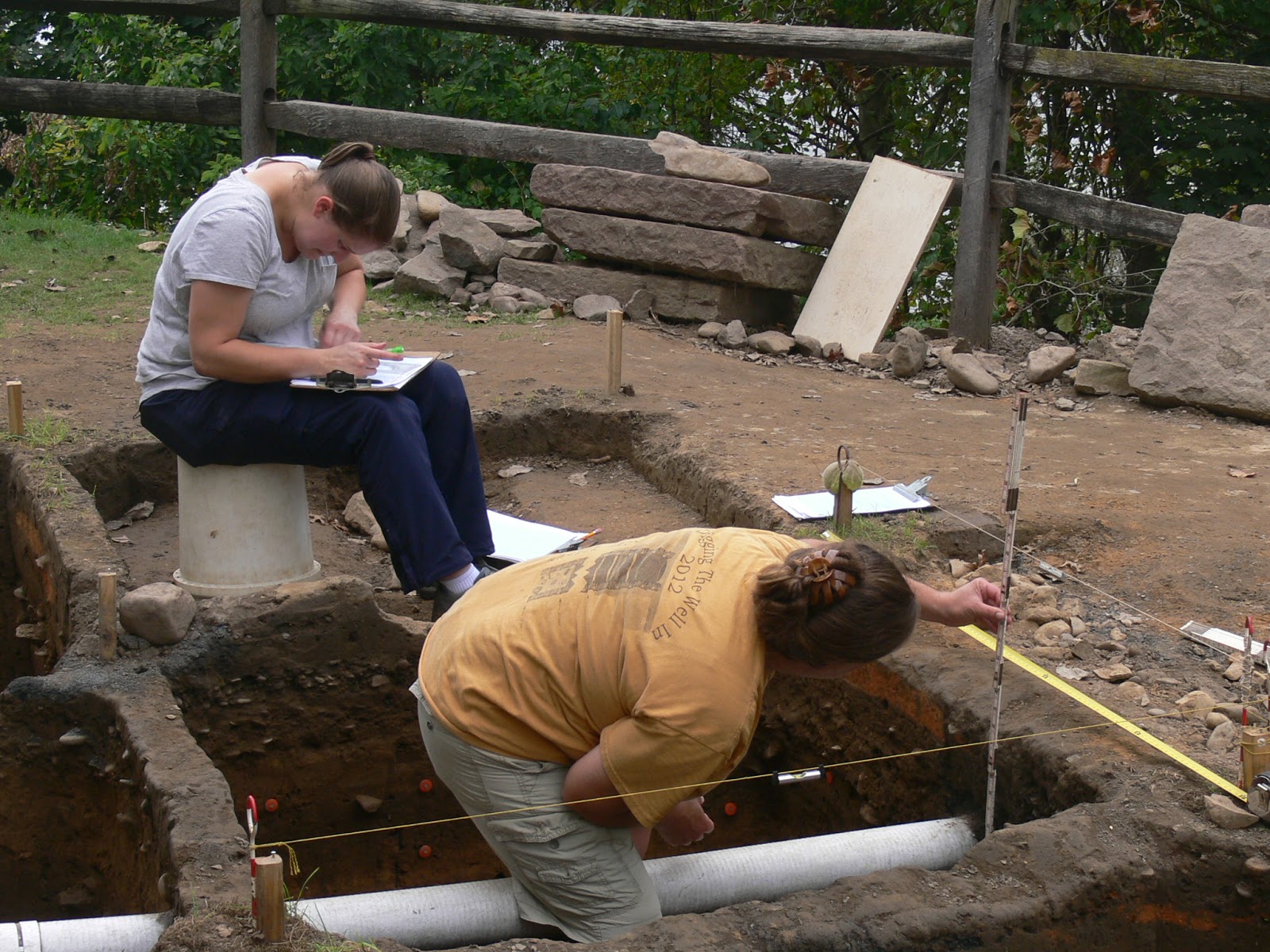
With the field season quickly drawing to a close, final levels were completed in the excavation block and then each profile, or wall, of the individual units was photographed and carefully hand mapped on graph paper to scale in order to record their stratigraphic sequence.

measuring and mapping profiles in unit with pvc drain pipe


The site was then “put to bed” by lining the walls and floors of each unit in the excavation block with heavy black plastic and weighted down with stone. The Fort Hunter ground crew has it all backfilled  for the safety of the park visitors during the rest of the year. 

overview of 2018 excavation block, looking West

The saying goes “you just can’t find good help these days”. In our case we have found good help, in the form of our dedicated volunteers. We can’t emphasize enough, the amount of work completed would not have been possible, nor as enjoyable without you, and we thank all of you for your enthusiasm and hard work!

Looking forward to more Archaeology Month events happening soon, Meadowcroft Rockshelter and Historic Village is hosting Archaeology Day tomorrow, Oct. 13th from 11AM to 5PM. Be sure to check their website for details.

Thursday, October 25th from 10AM to 1PM the Independence National Historic Park in Philadelphia will host a workshop on historic ceramic identification and its importance to archaeologists. More information can be found by clicking here.

And finally, just two weeks away, The State Museum of Pennsylvania will host the 2018 Annual Workshops in Archaeology series on Saturday, October 27 from 8:30AM to 6PM. This year’s topic, the culture history of the Susquehannock Indians from an archaeological context, will be explored in detail by nine 30-minute presentations throughout the day followed by a question and discussion forum, and concluding with light refreshments. Additional programming includes a flint knapping demonstration, artifact identification, and instruction on recording sites with the State Historic Preservation Office’s Cultural Resource Geographic Information System. 
Early registration discount ends Oct. 19th. Program abstracts and registration form can be found here

We hope to see you there!

For more information, visit PAarchaeology.state.pa.us or the Hall of Anthropology and Archaeology at The State Museum of Pennsylvania .

Friday, August 26, 2016

Upcoming Events - Fall 2016

     Labor Day weekend is traditionally considered the end of summer since it is time to go back to school, days are getting shorter and tans are beginning to fade. It also marks the beginning of a season full of public programming for the Section of Archaeology at the State Museum of Pennsylvania. 

Section of Archaeology Display at 2014 Kipona Festival


Kipona – September 3-5, 2016

Our kick-off event is Harrisburg City’s Kipona Festival on City Island celebrating the Susquehanna River. Our booth will be located on City Island, west of the baseball field. Look for the tall ARCHAEOLOGY banner with The State Museum of Pennsylvania and Pennsylvania Historical and Museum Commission logos.  Always popular is the replica 20 foot dugout canoe.  Stop by, have a seat in the canoe and learn about the prehistory of the Harrisburg area. Artifacts recovered from excavations on City Island in the 1990’s will be on display along with a few of the stone tools used to make the dugout.  Staff and volunteers from the Section will be present during the event to answer questions and offer insight into how people lived thousands of year ago. Brochures and other literature highlighting Pennsylvania archaeology will also be available.

Archaeological Excavations at Fort Hunter – September 7-October 7, 2016


Every fall since 2006 the Archaeology Section of The State Museum of Pennsylvania has led a month-long excavation at Fort Hunter Mansion and Park in Harrisburg, PA.  On September 7th, the search for the French and Indian War-period fort will resume. Prior excavations have documented thousands of years of human occupation at this spot overlooking the Susquehanna River that has served as a Native American campsite, a Colonial grist mill and trade location, a fort, and a Victorian-era farm. While previous years have been unsuccessful in locating the stockade or other fort structures, a new year brings new opportunities and expectations that this year’s excavations will prove successful.

One of the goals this year is to further investigate a circular stone foundation that appears to represent an octagon-shaped smoke house built by property owner Archibald McAllister in the early 1800s. Rather than building the fire inside the structure (a fire hazard), a stove was housed in a small attachment to the octagon. Investigations in this feature will hopefully confirm documentary research and add to our understanding of this early entrepreneur of Harrisburg efforts to build a successful business in the early nineteenth century. 

Stone Foundation of the Possible Smoke House at Fort Hunter

A second goal is to investigate the area immediately off the side porch of the original 1786 stone house. Folklore surrounding the location of the Fort Hunter blockhouse is that it now lies under this structure. Artifacts associated with Native Americans and military objects were found last year, so excavations will continue in this location in hopes of finding fort-related remains.
Come out and see what we find! Archaeologists will be on hand Monday-Friday, 9am-4pm to answer questions about the site and the archaeological process. In addition to weekdays, excavation will take place on Fort Hunter Day, to be held Sunday, September 18, 2016. Excavations will close for the year on October 7, 2016.

Workshops in ArchaeologyOctober 29, 2016
                The Archaeology Section of The State Museum of Pennsylvania invites you to attend the annual Workshops in Archaeology on Saturday, October 29, 2016. This annual program is designed to provide the general public with an overview of archaeological discoveries across the Commonwealth. This year’s theme is Understanding Symbols from the Past: Objects, Landscapes and Native American Beliefs
           What is the meaning behind petroglyphs, effigy mounds, beadwork, and images on pottery and smoking pipes? This year a series of presentations will focus on Indian symbolism in artifacts and on the cultural landscape.  Anthropologists have long examined symbols created by past cultures as a way of interpreting and understanding social, political or individual expression.  These take the form of abstract designs and depictions of animal, human and supernatural figures, frequently in stone and clay. The arrangement of earthworks and mounds also had meaning to people in the past.


Some of these symbols had religious connotations. Others represented clans or depicted supernatural beings that required appeasement. Although rarely found at archaeological sites, symbols on baskets or beadwork on clothing are also expressions of religious and cultural beliefs. They are reflections of how people perceived and organized their world. Symbolic artifacts recovered from the archaeological record provide a unique resource for examining past cultural behavior.  The presenters will examine the archaeological evidence of symbolism in Native American cultures and offer insights into their interpretations. 
In addition to the presentations, attendees can share their archaeological discoveries with staff from the State Historic Preservation Office who will provide assistance with identifying artifacts and recording archaeological sites, essential tasks for protecting and preserving our archaeological heritage. An additional offering includes a demonstration by a master flintknapper who will make stone tools using Native American techniques. A reception at the close of the sessions will provide an opportunity for the attendees to meet with the presenters and staff in the Anthropology and Archaeology Gallery of The State Museum.    
                The program and registration form will soon be available from our website. If registered before October 21, the cost is $25 for the general public or $15 for students and $15 for members of the Heritage Society, SPA, or PAC. The cost of registration at the door is $35.


                Finally, October is Archaeology Month in Pennsylvania.  The Society for Pennsylvania Archaeology will have programming throughout the Commonwealth that is open to the public as well as these opportunities offered through the State Museum. We hope to see you at one of our many upcoming events!

For more information, visit PAarchaeology.state.pa.us or the Hall of Anthropology and Archaeology at The State Museum of Pennsylvania .

Friday, November 12, 2010

Archaeology Day at the State Capitol

Wrapping up our celebration of Archaeology Month in Pennsylvania this year was the annual Archaeology Day at the State Capitol on Monday November 8th, held in the East Wing Rotunda. With so much happening in the world of archaeology, we just couldn’t contain everything to the month of October. Archaeology Day at the Capitol is one of the few times a year when the archaeological community has the opportunity to interact face to face with elected officials to impress upon them the value of archaeology and “make the case” for bolstering legislative support.

An additional aspect of the program included undergraduate students from Indiana University of PA, Edinboro University of PA and West Chester University presenting posters on recent archaeological fieldwork from their respective institutions. State Museum Section of Archaeology staff was also on hand with a new poster highlighting the past five field seasons of investigations at Fort Hunter Mansion and Park. The now nearly-famous cannon ball recovered there in 2008 was also on display.


Invited as featured guest speakers, Neil and Francine Patterson of the Tuscarora Nation gave a special presentation to third and fourth graders from St. Stephen’s Episcopal School and 7th graders from the Catherdral School in Harrisburg. Students were introduced to the heritage and culture of the Tuscarora including learning the difference between native corn and modern hybrid varieties, and the significance of wampum to native peoples. Thanks to Neil and Francine for making the trip from upstate New York to share their history of the Tuscarora with us.

Afterwards the students participated in an exercise to produce cordage, an everyday yet essential material in prehistoric technology. Hands-on activities such as this engage young people and can open the door to an enriched appreciation for indigenous cultures.

For more information, visit PAarchaeology.state.pa.us or the Hall of Anthropology and Archaeology at The State Museum of Pennsylvania .

Friday, September 10, 2010

It’s Almost Archaeology Month so… It's Fort Hunter time!

During Archaeology Month 2010, archaeologists from The State Museum of Pennsylvania will return to Fort Hunter for the fifth field season. This week, the backfill from last year was being removed and new excavations will begin early next week.


The project is located at Fort Hunter Mansion and Park, five miles north of the capitol in Harrisburg.


The goal is to locate the remains of the French and Indian War era supply fort occupied between 1757 and 1763. Fort Hunter was part of a chain of three forts built along the Susquehanna River by the British in the mid-1750s at the outset of the French and Indian War. The largest of these was Fort Augusta, located at the confluence of the North and West braches of the Susquehanna River at Sunbury. This was a massive military installation, with earthen walls over 700 feet long. The second fort was located at Halifax, about 20 miles north of Harrisburg. Based on historic documents, Fort Halifax was square with wooden walls or a stockade that measured 160 feet on a side.


Fort Hunter was designed as a supply fort. However, there are no verifiable accounts that anything more than a blockhouse was actually ever built, and the exact location of a stockaded fort has long been debated. There is a reference that the logs for the stockade had been cut, but there are no accounts of the posts ever being erected. The site is currently being interpreted as a 19th-20th- century manor and farm.


In 2006, we uncovered what we believed to be a fort related bake oven. Munitions discovered at the site include musket balls, bird shot and a four pound cannon ball.


Numerous gunflints have been found. Of note is a gunflint which still retains a lead patch, a method associated with the military.


In addition, numerous other fort period artifacts and features have been recovered - some of these may be part of the fort occupation or they may relate to the earlier Samuel Hunter farmstead or the later Col. McAlister house. The stockade and the blockhouse, however, have yet to be located.

The goals for this year include two main objectives.
We will continue to search for the fort’s stockade line and/or surrounding ditch by expanding on excavations in the east yard begun last year. At the end of the 2009 season, a section of thickened A horizon was encountered in this area. This feature is approximately 15 feet wide and had an average depth of 15 to 28 inches. The artifacts from this feature were a hodgepodge of ferrous metal objects, a glass wine bottle fragment and a Lamoka projectile point. This feature still holds the possibility of relating to the fort occupation.

The second area of interest is the block excavation in the north side yard of the mansion.


This area contains several interesting features discovered in 2008 and 2009. The largest is a stone “waterwell”. This structure is adjacent to a 1794 icehouse and this year we hope to resolve the chronological relationship between these two structures. This was the goal of last years investigation but the complicating factor has been the stratified prehistoric material all around the “well”. Removing these artifacts required careful documentation of location and position and consumed more time than planned. We still need to remove several levels of soil in this area prior to investigating the “well”. Complicating the interpretation of the “well” was the discovery of an iron pipe entering this structure seven feet below the surface at the very end of the 2009 season. What we thought was a waterwell may be a cistern and dating to the 19th century rather than to the fort period. Historic site archaeology can be very complicated and it is often difficult to interpret ground disturbances but we are hopeful this season’s investigation will resolve the “well” issue.

Finally, ten feet north of the well/cistern is a line of rocks that we initially thought was a walkway. However, by the end of the 2009 season, when we had cleared the upper levels, it is now being interpreted as a possible building foundation. This will require an expansion of the block and, again, the excavation of a substantial prehistoric occupation.

Come visit us at Fort Hunter Park http://www.forthunter.org/ .Our project is part of Pennsylvania’s “Archaeology Month” celebration in September and October. Excavations are open to the public for viewing, weekdays from 9:00 am until 4:00 pm, weather permitting. For more information on Fort Hunter or the archaeology of the Susquehanna Valley, visit PAarchaeology.state.pa.us or the Hall of Anthropology and Archaeology at The State Museum of Pennsylvania.


For more information, visit PAarchaeology.state.pa.us or the Hall of Anthropology and Archaeology at The State Museum of Pennsylvania .